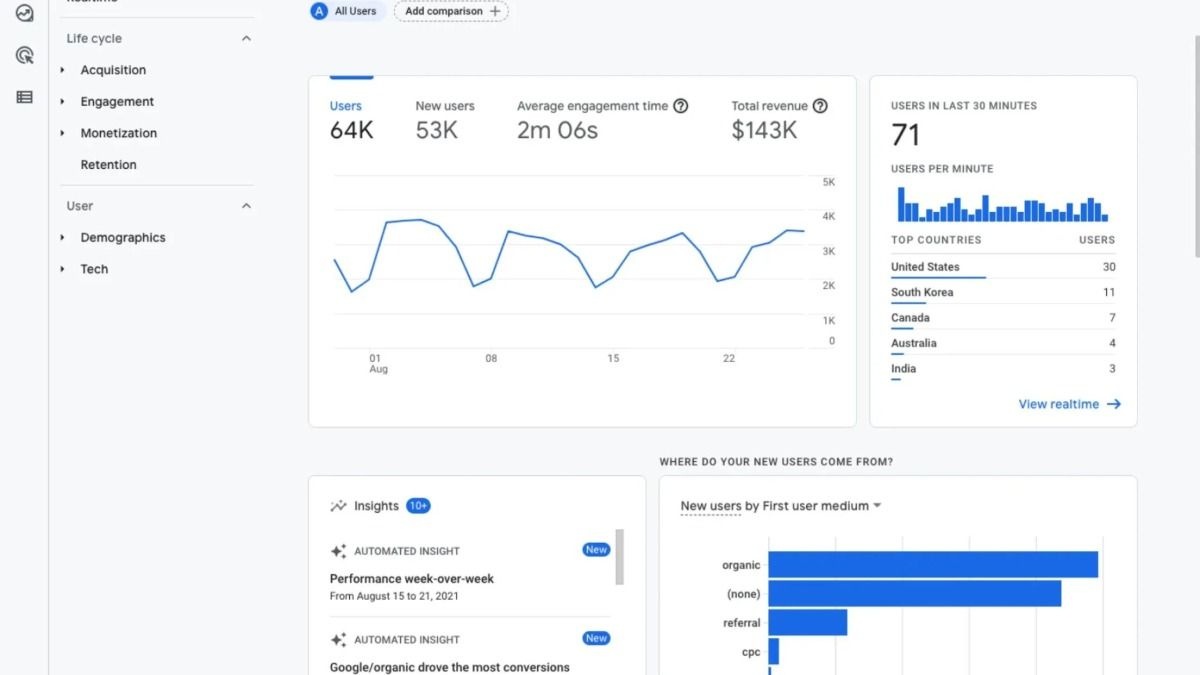
You open your analytics dashboard on a Tuesday morning and something looks wrong. Not catastrophically wrong. Just wrong enough that you stop scrolling and stare at it.
The graph has a cliff in it. Right around the time Google pushed a major update, your organic traffic falls by roughly half. Not a slow decline. A drop. The kind that makes your stomach do a thing.
So you check rankings. You're still number one for your main keyword. You pull up Google Search Console and impressions are actually up. More people are seeing your page in search results than ever before. But clicks are down. Way down. You're getting half the clicks from the same number of impressions you always got.
You spend an hour refreshing tools, checking for a technical issue, wondering if your site got penalized. Nothing. No manual action. No crawl issues. You just rank number one and get far fewer people visiting your site than you used to.
ℹ️The Stat That Defines the New Era
The number one organic ranking position had an average CTR around 76% before Google AI Overviews became widespread. With AI Overviews present on a results page, that CTR drops to approximately 38%. Same ranking. Half the traffic.
This is the Google AI Overviews story, and it's playing out in analytics dashboards across every niche in 2026. Content creators, bloggers, SEO professionals, and business owners who built traffic moats over years are watching those moats drain. Not because they did anything wrong. Because Google changed the game at the SERP level itself.
When a person searching for something gets a direct answer synthesized right on the results page, many of them never click through to any website. Why would they? They got the answer.
Top organic position CTR drop on queries with AI OverviewsSeer Interactive, Authoritas, SparkToro aggregate analysis
Share of all Google searches now triggering an AI OverviewEstimated 2026 figure across major tracking tools
The Data
Let's get specific. Vague claims about traffic drops get thrown around constantly in the SEO world. What's different here is that multiple research organizations have run the numbers independently and reached consistent conclusions.
- Seer Interactive published analysis tracking CTR changes across thousands of keywords before and after AI Overviews appeared, with consistent compression at the top position concentrated on informational queries
- Authoritas ran a large-scale study examining AI Overview presence correlated with organic click-through, finding similar compression patterns across their dataset
- SparkToro analysis of zero-click search behavior showed AI Overviews accelerated a trend that had been building for years
CTR impact by query type with AI Overview present
| Query Type | CTR Impact | Why |
|---|
| Informational ('what is X') | −50% to −65% | AI can synthesize a competent answer directly |
| How-to / step-by-step | −45% to −60% | Summary often sufficient for task completion |
| Definition / glossary | −60%+ | Essentially absorbed entirely |
| Comparison ('X vs Y') | −25% to −40% | AI shows comparison tables; commercial intent helps |
| Commercial / transactional | −5% to −15% | Purchase intent still requires a visit |
| Navigational (brand) | Minimal | Searcher needs to reach a specific destination |
| Local ('X near me') | Minimal | Routes through local packs and maps |
⚠️The Zero-Click Acceleration Problem
The zero-click search phenomenon predates AI Overviews. Featured snippets, knowledge panels, and answer boxes were already pulling traffic away. AI Overviews didn't invent the problem. They turbocharged it. Content strategies that survived the featured snippet era are now experiencing the same disruption again, faster and at larger scale.
The uncomfortable truth in the data is that Google's core incentive here is not publisher welfare. Google monetizes through ads, and keeping users on the SERP longer, engaged with AI Overviews rather than leaving to publisher sites, serves Google's ad business. The CTR compression you're experiencing is not a bug in the system. It is the system working as Google designed it.
Not all content gets buried. Some content gets cited. Understanding the difference between content that gets cited in an AI Overview versus content that simply gets summarized and replaced is where the real strategic opportunity lives.
When Google's AI constructs an Overview, it is pulling from sources it has already indexed and ranked. It works from the same corpus as regular search. But the selection mechanism for citation is different from the selection mechanism for ranking.
E-E-A-T and Citation Probability
Experience, Expertise, Authoritativeness, and Trustworthiness — the E-E-A-T framework — has never mattered more. The sites that get cited in AI Overviews consistently show high E-E-A-T signals. Author credentials are visible and verifiable. Publication history shows domain specialization. The content demonstrates first-hand experience rather than just aggregating information.
A blog post written from personal experience with a specific medication, by someone with a medical credential and a detailed author bio, is far more likely to be cited than a generic health article assembled from other articles.
The Featured Snippet Connection
AI Overview citation sources heavily overlap with featured snippet sources. If your content has historically earned featured snippets for a query, it has a much higher probability of being cited in an AI Overview for the same query. The featured snippet optimization playbook still applies — and then some.
The difference is that being cited in an AI Overview may not drive clicks the way winning a featured snippet used to.
Passage Length and Direct Answer Structure
Research into AI Overview citation behavior has identified a passage length sweet spot around 134 to 167 words for citation-worthy paragraphs. Not a magic number to optimize to, but it reflects the reality that AI systems are looking for complete, self-contained answers that are long enough to be substantive but short enough to be extractable.
Content that opens a section with a clear, direct answer — before providing supporting detail — is far more citation-friendly than content that builds to an answer in the conclusion. Inverted pyramid structure: the most important answer first, then the supporting evidence and nuance.
The sites that benefit from AI Overviews are the ones Google already trusts to be accurate. AI Overviews don't create new trust relationships. They amplify existing ones.
ℹ️Cited vs. Summarized
There is a meaningful difference between having your content cited in an AI Overview (with a visible link and your domain showing as a source) and having your content absorbed without attribution. The former gives you brand visibility. The latter is content Google consumed and gave nothing back for. Your goal is to be cited, not just sourced.
What Still Works
The AI Overview era does not mean organic search is dead. It means the types of content that reliably drive organic clicks have shifted.
Commercial and Transactional Content
When someone is ready to spend money, they click. AI Overviews can provide a general overview of options in a category, but they cannot substitute for the actual purchase experience. Product pages, pricing pages, comparison pages with affiliate links, review pages — these retain click-through because the AI Overview cannot satisfy the searcher's intent.
Genuine Depth That AI Cannot Replicate
There is a category of content that AI Overviews cannot summarize adequately because the depth is the entire point. Long-form investigative pieces. Content based on original research and proprietary data. Case studies with specific numbers and real outcomes. Detailed technical tutorials where the nuance matters and a summary version is actively misleading.
If someone is genuinely trying to understand something at a level that requires reading 3,000 words, they will click through.
Opinion, Analysis, and Expert Perspective
AI cannot have a genuine opinion. It can simulate one, but Google's AI Overviews are extremely conservative about attributing specific viewpoints to specific people. Opinion content, editorial analysis, first-person expert perspectives — these are difficult for AI Overviews to handle cleanly.
This is one of the strongest arguments for building a genuine voice in your content rather than writing encyclopedia-style neutral coverage. The more your content is specifically yours, the less replaceable it is by AI synthesis.
Tool-Based Content
If your content is built around a tool that users need to actually use, AI Overviews cannot replace it. A salary calculator. A budget template. A code snippet. An interactive quiz. The content that exists as a vehicle for a tool drives clicks because the tool is what they actually need.
Community and Forum Content
Reddit's traffic has surged in the AI Overview era. This is not a coincidence. Reddit threads show up in AI Overview citations constantly, and users click through to read the full discussion because a summary of a thread is not the same as the thread. The social dynamics, the upvoted comments, the specific individual experiences — these cannot be synthesized.
💡The Practical Reframe
Stop thinking about content as "ranking for keywords." Start thinking about content as "satisfying intent that cannot be satisfied by a paragraph." Every piece you publish should have a clear answer to: what does this person need that the AI Overview cannot give them? That question should shape your content strategy entirely.
From Traffic-Focused to Authority-Focused
The old content strategy logic: rank for high-volume keywords, get traffic, convert a percentage of that traffic, grow revenue. The implicit assumption was that traffic was the scarce resource.
In the AI Overview era, traffic is no longer the primary output of good content. Authority is. A piece of content that earns consistent AI Overview citations, generates brand recognition, builds email subscriptions, and earns backlinks is doing more for your business than a piece that used to rank number one and is now seeing 50% less traffic to show for it.
Original Data and Research as a Structural Moat
There is no substitute for original research. Content built on data that only you have cannot be absorbed and synthesized away because the data doesn't exist anywhere else. A survey you ran with 500 respondents in your niche. An analysis you ran on proprietary transaction data. A database you built by hand over two years.
Most content creators underestimate how achievable this is. You don't need a data science team. You need a SurveyMonkey account and 200 respondents, or a unique angle on publicly available data that nobody has analyzed that way.
Email List as Traffic Independence
The most durable version of the content strategy shift is building direct distribution that doesn't depend on Google at all. An email list gives you the ability to reach your audience regardless of what Google's algorithm does next month. In the AI Overview era it is structural necessity.
Every piece of content you publish should have a clear email capture mechanism. Not a weak banner that says "subscribe to our newsletter." A specific lead magnet that extends the value of the piece they just read. A calculator they want. A template they need. A short email course on the exact topic they were researching.
The New Metrics That Matter
Shifting from old to new content performance metrics
| Old Metric | New Metric | Why It Changed |
|---|
| Organic traffic volume | AI Overview citations earned | Traffic is being absorbed; citations signal authority |
| Keyword rankings | Brand search volume growth | Rankings drive less traffic; brand search is insulated |
| Bounce rate | Email subscription rate | Single-visit traffic matters less; recurring audience matters more |
| Impressions | Cited source frequency | Impressions up as CTR drops; citation shows you matter |
| Page views | Return visitor rate | Volume is down; loyalty signals audience quality |
There is a specific irony worth examining. AI Overviews are hurting content creators while simultaneously, many of those same content creators adopted AI-generated content as their main production method over the past two years. The combination is punishing in both directions.
Doubly Disadvantaged
AI-generated content is disadvantaged in the AI Overview era for two compounding reasons:
- It's less likely to be selected as a citation source because it lacks the authentic E-E-A-T signals Google's systems favor
- It's more likely to be absorbed and summarized without driving clicks because it tends to be informationally dense but authentically thin
Sites that built large content inventories of AI-generated informational articles are now watching those articles generate impressions and no clicks, while simultaneously failing to earn the citation credit that would at least give them brand visibility. They have all the downside of AI Overviews with none of the upside.
The Authenticity Premium
There is now a measurable premium on authentic human writing in search. Not because Google is ideologically opposed to AI content, but because authentic human writing tends to carry the experience and expertise signals that Google's systems are selecting for.
The authenticity premium is not about the production method per se. It's about the signals the content carries. A human who writes in a generic, formulaic way produces content with weak authenticity signals. An AI-assisted human who genuinely knows their subject, who edits for voice and specificity and original perspective, produces content with strong authenticity signals.
ℹ️The Pattern Google Appears to Favor for Citation
Content that gets cited consistently shows: named human author with verifiable credentials, publication on a domain with established authority in the topic area, specific factual claims with cited sources, direct answer structure at the section level, and genuine specificity that resists generic summarization. AI-generated content lacking these signals ranks fine but earns citations at significantly lower rates.
Schema Markup Types That Matter
FAQ schema is the single most valuable schema type for AI Overview optimization. Pages with proper FAQ schema show meaningfully higher AI Overview citation rates than comparable pages without it.
HowTo schema matters for instructional content. Article and NewsArticle schema reinforce authorship and publication date signals, contributing to trustworthiness. Breadcrumb schema helps Google understand your site's topic architecture.
Page Structure That AI Parsers Favor
Clear heading hierarchy. H1 for the page title, H2 for major sections, H3 for subsections. Within each section, the inverted pyramid structure: the most important, extractable answer first, then supporting context. This is the opposite of how academic writing traditionally works but it's how Google's extraction systems work best.
Avoid dense blocks of text with no structural breaks. Google's passage-level indexing works better when passages have clear boundaries.
Core Web Vitals Standards for 2026
Largest Contentful Paint under 2.5 seconds. First Input Delay under 100 milliseconds. Cumulative Layout Shift under 0.1. These are achievable for most content sites without heroic engineering effort. Focus on image optimization, removing unused JavaScript, and leveraging browser caching.
Your Playbook
Step-by-Step: Auditing and Adapting to the AI Overview Era
Run the CTR Audit in Search Console
Export your top 50 pages by impressions over the past 12 months. Calculate CTR for each page. Sort by the biggest gap between high impressions and low CTR. These are your AI Overview-affected pages. Any page with impressions up year-over-year but CTR significantly down is showing the AI Overview signature. Document this list before you do anything else.
Classify Your Content by Query Type
For each page, classify its primary query intent as informational, commercial, or navigational. For informational pages, assess whether the content provides depth requiring a click-through, or whether it answers a question an AI can adequately synthesize. Be honest. Content that provides genuine depth, original data, or first-hand experience has a path to recovery.
Prioritize Your Update Queue
Three categories: content worth updating for citation optimization, content worth converting to bottom-of-funnel commercial content, and content that should be consolidated or removed. Content worth updating has high authority, addresses topics where you have genuine expertise, and is currently missing FAQ sections, strong author attribution, or direct answer structure.
Update Author Attribution on All Key Pages
Ensure the author is a named human with a verifiable role, a visible bio that demonstrates relevant expertise, and a consistent byline across multiple articles. This is not about gaming the system. It's about giving Google the E-E-A-T signals it needs. If your articles are published under a generic byline or no byline at all, fix this before anything else.
Restructure Sections for Direct Answer Format
Take your top 20 highest-impression pages and restructure them. Each H2 section should open with a direct answer paragraph of 100 to 175 words that answers the sub-question implied by the section heading. This answer should be complete and self-contained, not dependent on what came before.
Add FAQ Sections with Schema Markup
Add a minimum of 6 to 8 FAQ items to each key page, using actual questions from People Also Ask and autocomplete research. Each answer should be 75 to 150 words. Implement FAQ schema markup. Test with Google's Rich Results Test tool.
Audit and Expand Your Bottom-of-Funnel Content
Map your content inventory against your actual conversion funnel. What questions do buyers have right before they decide to purchase? Create content for those questions. Comparison pages, pricing explainers, alternative pages, and use-case specific content all belong in this tier.
Build or Strengthen Your Email Capture System
On every page with significant traffic, add a specific, relevant lead magnet. A guide about keyword research should offer a keyword research template. A generic newsletter signup will convert at under 0.5%. A specific, highly relevant lead magnet will convert at 3-8%.
Start an Original Data Asset
Choose one topic where you can collect original data no one else has. Run a survey. Analyze public datasets with a novel methodology. One original data asset published per quarter builds a citation-worthy content inventory that compounds over time.
Set Up Citation Monitoring
Manually search for your target keywords and note when your domain appears as an AI Overview citation source. Third-party tools like Semrush and Ahrefs have begun building AI Overview tracking features. Set up weekly monitoring for your top 20 target queries.
Common Mistakes
⚠️Mistake #1: Publishing More Informational Content Faster
The instinct when traffic drops is to produce more content. In 2026, it's actively counterproductive for informational content. More AI-generated informational articles are exactly the content type that AI Overviews absorb and replace. The volume play no longer works.
⚠️Mistake #2: Abandoning SEO Entirely
The overcorrection is also wrong. Commercial queries still drive significant organic traffic. Brand search is growing. Abandoning SEO in response to AI Overviews is like abandoning retail because e-commerce hurt foot traffic. The channel changed. The channel didn't die.
⚠️Mistake #3: Optimizing for Citation as Your Primary Strategy
Citation drives brand visibility but lower click-through than a number one ranking used to. Building your entire strategy around getting cited is optimizing for a secondary metric. Citation should be a byproduct of good content, not the primary goal.
⚠️Mistake #4: Ignoring Bottom-of-Funnel Content
Content creators focused exclusively on informational articles are in the worst position. If your inventory is heavily weighted toward informational, the work isn't to fix those articles. It's to start building the commercial content you should have been building all along.
⚠️Mistake #5: Treating All Traffic as Equivalent
Not all traffic lost to AI Overviews was valuable traffic. Informational searchers who got their quick answer were often not converting anyway. The traffic AI Overviews absorbed was often the lowest-value traffic in your analytics. The content creator who loses 50,000 monthly visits but retains all their converting traffic has not lost 50% of their business.
⚠️Mistake #6: Not Building an Email List
Every day you publish without building your email list is a day you're increasing your dependency on Google's traffic decisions. The email list is the asset that is immune to algorithm changes. If you don't have a strong email capture mechanism on every page, fix that before anything else.
⚠️Mistake #7: Copying What AI Overviews Say
Some content creators, in an attempt to optimize for citation, are now writing content that mirrors what AI Overviews say on their topics. This is backwards. AI Overviews are synthesizing content that already exists. If your content looks like an AI Overview, you're writing content AI already replaces adequately.
A mid-sized health information site with content across hundreds of topics had built years of traffic on informational health queries. The AI Overview rollout hit this type of site hardest — informational health content is exactly what Google's AI Overview handles confidently.
Sites in this category commonly saw 40 to 60% CTR drops on their informational content. The content that performed better shared characteristics: strong author attribution from named medical professionals, nuanced questions where synthesized answers required more context, and patient experience content where first-hand accounts couldn't be adequately summarized.
The recovery strategy involved shifting emphasis toward clinical tools (symptom checkers, drug interaction calculators), condition-specific deep-dive content written by specialists, and patient community content.
The Solo SEO Blogger
A solo blogger who built content around SEO topics had traffic predominantly informational. The AI Overview impact is bifurcated. Informational content ("what is keyword density," "how to do competitor analysis") saw dramatic CTR compression. But affiliate content ("best SEO tools for small businesses," "Ahrefs vs Semrush comparison") retained traffic much better because commercial intent requires evaluation, not just information.
The adaptation: publish fewer, more substantive informational pieces and shift affiliate content toward being more specific and experience-based. A comparison article that includes the author's actual test results, with specific screenshots and first-hand experience notes, is much harder for AI Overviews to absorb.
The B2B SaaS Content Team
For SaaS companies, the content marketing traffic that was most directly valuable — bottom-of-funnel content that drove trial signups — is the content that AI Overviews affect least. The traffic that was lost was largely top-of-funnel awareness traffic that converted at very low rates anyway.
The strategic lesson: B2B SaaS content teams should prioritize what was always more valuable — specific product use cases, integration documentation, customer success stories, and competitive differentiator content.
The Recipe and Food Publisher
Recipe content has been heavily affected. "How to make [dish]" queries frequently trigger AI Overviews with summarized ingredient lists and step-by-step instructions. The adaptation strategies that work include: video content embedded in recipe articles, highly specific recipes where specificity resists summarization, personal food stories and cultural context that can't be extracted cleanly, and food science explanations that go deeper than an AI Overview can convey.
The 76% to 38% drop is real. The trajectory toward more AI Overview presence continues. But the content types that work, the strategies that build durable audiences, and the metrics that actually measure business value have all shifted simultaneously.
The Core Adaptation
Shift from traffic-focused to authority-focused. Build original data. Build an email list. Prioritize commercial content and genuine expertise. Write content that satisfies intent AI cannot satisfy with a paragraph. The content creators who adapt to these realities will find that the AI Overview era, for all its disruption, still rewards genuine excellence. The ones who try to produce more of the same, faster, will watch their traffic continue to compress toward zero.
The channel changed. The channel didn't die. Adapt accordingly.