The digital landscape has been irrevocably transformed by the advent of large language models (LLMs) like ChatGPT, offering unprecedented capabilities for content generation. While these AI tools provide incredible efficiency and scale, their output often carries a distinct, often robotic, signature. This 'AI-ness' can lead to bland, unengaging content that struggles to connect with human readers, risks being flagged by increasingly sophisticated AI detectors, and ultimately undermines your brand's authenticity and SEO performance. The challenge, therefore, isn't just about generating content, but about generating content that resonates as genuinely human.
In a world saturated with AI-generated text, the ability to humanize ChatGPT output has become a critical skill for content creators, marketers, academics, and businesses alike. Whether you're aiming to bypass strict AI detection algorithms in educational settings, enhance your search engine optimization (SEO) by adhering to Google's E-E-A-T guidelines, or simply build stronger connections with your audience through authentic narratives, transforming raw AI text is essential. This in-depth guide will equip you with the advanced strategies, both manual and automated, to elevate your AI-generated content from merely functional to truly exceptional, ensuring it passes for human-written every single time.
While ChatGPT and similar LLMs are astonishingly capable, their underlying architecture leads to predictable patterns in text generation. They operate by predicting the most probable next word based on vast datasets, which inherently fosters a particular style. This style often manifests as a lack of unique voice, an overreliance on common phrases, a tendency towards formal or didactic tones, and a striking absence of the nuanced idiosyncrasies that define human communication. Recognizing these patterns is the first step toward effective humanization, as it allows us to target specific areas for intervention.
The limitations of raw AI output extend beyond mere stylistic concerns; they pose significant practical challenges. For instance, content that is overtly AI-generated often struggles to rank well on search engines, as Google increasingly prioritizes original, high-quality, and helpful human-created content that demonstrates expertise, experience, authoritativeness, and trustworthiness (E-E-A-T). Moreover, the risk of detection by AI scanners is ever-present, potentially leading to academic penalties, professional credibility issues, or even outright rejection of content in various professional contexts. This makes humanization not just a stylistic choice, but a strategic imperative for anyone using AI in content creation.
Key Indicators of AI-Generated Text
- **Predictable Sentence Structures**: A consistent cadence, often lacking the varied lengths and complexities found in human writing.
- **Formal and Impersonal Tone**: A tendency to avoid colloquialisms, slang, or personal anecdotes, leading to a detached feel.
- **Repetitive Phrasing and Vocabulary**: Overuse of specific transition words, adverbs, or common explanatory clauses (e.g., 'In conclusion,' 'It is important to note that').
- **Lack of Nuance and Subtlety**: Direct, declarative statements without the subtle emotional inflections, irony, or ambiguity inherent in human expression.
- **Generic Examples or Analogies**: Reliance on universally understood, often simplistic examples rather than specific, relatable, or novel instances.
- **Absence of Personal Experience or Opinion**: A neutral, objective stance that avoids subjective viewpoints, storytelling, or direct engagement with the reader.
- **High Perplexity and Low Burstiness Scores**: AI detectors often analyze these metrics, where perplexity measures text randomness and burstiness measures sentence variation. AI text typically has low burstiness.
ℹ️Understanding Perplexity and Burstiness
AI detectors frequently analyze two key linguistic metrics: perplexity and burstiness. Perplexity quantifies how well a language model predicts a sample of text; lower perplexity means the text is highly predictable. Burstiness, on the other hand, measures the variation in sentence length and structure within a text. Human writing often exhibits high burstiness, with a mix of long, complex sentences and short, punchy ones. AI-generated text, by contrast, tends to have lower burstiness, maintaining a more uniform sentence structure that AI detectors can easily flag.
The rationale for meticulously humanizing AI-generated content extends far beyond simply avoiding detection; it's about competitive advantage, audience engagement, and maintaining integrity. In a crowded digital space where everyone has access to similar AI tools, the differentiator lies in the authenticity and quality of your message. Businesses, educational institutions, and individual creators are all grappling with the implications of pervasive AI content, making humanization a critical skill for navigating this new landscape effectively.
1. Bypassing AI Detection Algorithms
Perhaps the most immediate and tangible benefit of humanizing AI text is the ability to circumvent sophisticated AI detection tools. Platforms like Originality.ai, GPTZero, Turnitin, and Copyleaks are constantly evolving, employing advanced machine learning models to identify patterns indicative of AI authorship. Content that scores high on AI detection is often penalized, whether through academic integrity violations, reduced visibility in search results, or rejection by discerning editors and clients. Humanizing your content explicitly targets these AI signatures, making your text virtually indistinguishable from human-written material.
🔑AI Detection Evasion Rates
Internal research at HumanLike.pro demonstrates that raw ChatGPT output frequently registers AI detection scores of 80-100% on leading commercial detectors. After processing through HumanLike.pro's advanced humanization engine, the same text consistently achieves detection scores below 1%, effectively rendering it undetectable as AI-generated by 99% of current tools, even those designed for specific AI models like GPT-4.
2. Elevating SEO Rankings and E-E-A-T
Google's relentless focus on 'helpful content' and its E-E-A-T (Experience, Expertise, Authoritativeness, Trustworthiness) guidelines makes humanized content a cornerstone of effective SEO strategy. Generic, templated AI text often lacks the depth, unique perspectives, and authentic voice that Google rewards. By injecting personal experience, original research, nuanced opinions, and a distinct human touch, you signal to search engines that your content is genuinely valuable and produced by knowledgeable individuals, thereby improving its chances of ranking higher and attracting organic traffic. The Helpful Content Update specifically targets content that seems to be produced solely for search engines rather than for human readers, making humanization a direct counter-measure.
3. Enhancing Reader Engagement and Trust
Humans inherently connect with other humans. Content that sounds authentic, empathetic, and relatable fosters a deeper connection with your audience. Raw AI text, with its often sterile and formal tone, struggles to evoke emotion, build rapport, or inspire trust. Humanizing your output by incorporating storytelling, personal anecdotes, humor, and a conversational style can transform a dry article into an engaging narrative. This heightened engagement translates into longer time-on-page, lower bounce rates, and a more loyal readership, which are all crucial metrics for content success.
4. Preserving Brand Voice and Authenticity
Every brand has a unique voice, a specific way it communicates with its audience. Relying solely on raw AI output risks diluting this carefully crafted identity, leading to a generic, undifferentiated brand presence. Humanizing your ChatGPT text allows you to infuse your brand's specific personality, values, and communication style into every piece of content. This consistency reinforces brand recognition, builds brand loyalty, and ensures that your message always aligns with your overarching brand strategy, preventing your content from sounding like every other AI-generated piece on the internet.
5. Avoiding Academic and Professional Penalties
In academic and professional fields, the use of uncredited AI-generated content can carry severe consequences, ranging from failing grades and academic probation to professional sanctions or damaged reputations. Educational institutions and ethical review boards are increasingly vigilant, utilizing sophisticated tools to detect AI plagiarism. Humanizing your AI-assisted work ensures that it meets the authenticity requirements of these critical environments, allowing you to leverage AI for efficiency without compromising integrity or facing punitive measures. It's about using AI as an aid, not a replacement for original thought.
When it comes to transforming AI-generated text, you fundamentally have two paths: manual editing by a human or utilizing specialized AI humanizer tools. Both have their merits and drawbacks, and the optimal strategy often involves a synergistic combination of the two. Understanding the nuances of each approach is key to selecting the most efficient and effective method for your specific content needs and objectives. Many content creators find themselves weighing the time investment of manual edits against the efficiency of automated solutions, a decision often influenced by scale and budget.
Manual Humanization Techniques: The Art of the Human Editor
Manual humanization involves a hands-on, meticulous editing process where a human writer or editor refines the AI-generated text. This approach allows for unparalleled control and the deepest level of personalization. It demands a keen eye for detail, a strong understanding of linguistic nuances, and the ability to imbue text with a unique voice and perspective. While time-consuming, it is the most reliable method for achieving truly bespoke content that perfectly aligns with specific stylistic requirements and brand guidelines, often resulting in truly exceptional pieces that stand out.
Phase 1: Pre-Prompting Strategies for Better Initial Output
Define a Persona and Tone
Before generating any text, clearly instruct ChatGPT on the persona it should adopt (e.g., 'a witty tech blogger,' 'an empathetic medical expert,' 'a straightforward business analyst'). Specify the desired tone (e.g., 'conversational,' 'authoritative,' 'humorous,' 'academic'). The more specific your instructions, the better the initial output will be, reducing the need for extensive post-generation editing. For example, 'Act as a seasoned content strategist explaining the future of SEO to small business owners in an engaging, slightly informal tone.'
Specify Target Audience and Context
Tailor the output by telling ChatGPT who the content is for and where it will be published. This helps the AI use appropriate vocabulary, examples, and rhetorical devices. For instance, 'Write for marketing executives on LinkedIn, focusing on actionable insights and industry trends' versus 'Explain quantum physics to a high school student using simple analogies.' This contextual information dramatically refines the AI's understanding of its task, leading to more relevant and human-like prose.
Provide Examples of Desired Style
One of the most effective ways to guide ChatGPT is by providing actual examples of the writing style you want to emulate. Paste a paragraph or two of your preferred human-written content and instruct the AI to 'write in a similar style,' 'mimic the tone and structure of this text,' or 'adopt the vocabulary choices seen in this example.' This method provides a concrete reference point that generic instructions often lack, enabling a much closer stylistic match.
Incorporate Specific Keywords and Phrases
While AI can generate content around keywords, explicitly instructing it to integrate certain key phrases, industry jargon, or unique brand terminology can make the output more specialized and less generic. For instance, ask it to 'ensure integration of terms like 'hyper-personalization,' 'AI-driven analytics,' and 'customer journey mapping'' to ensure your content is relevant and uses specific language common to your niche.
Request Varied Sentence Structures and Pacing
Counteract AI's tendency for uniform sentence length by prompting it to 'use a mix of short, impactful sentences and longer, more descriptive ones.' You can also ask for 'dynamic pacing' or to 'start paragraphs with varying structures' to enhance readability and make the text less predictable. This directly addresses the 'low burstiness' issue often flagged by AI detectors, making the text flow more naturally.
Phase 2: Post-Generation Editing – Injecting the Human Element
1. Inject Personal Anecdotes and Examples
AI struggles with genuine personal experience. Replace generic statements with specific, relatable stories or hypothetical scenarios. 'Instead of saying 'AI improves efficiency,' say 'Just last month, our team saved 15 hours on reporting thanks to implementing an AI-driven automation workflow.' This grounds the content in reality and makes it more compelling. Humans relate to stories, not just facts. Think about how a human would illustrate a point based on their own lived experience or observations.
2. Vary Sentence Structure and Length
AI often produces sentences of similar length and structure. Actively diversify them. Combine short, punchy sentences with longer, more complex ones. Start sentences with different parts of speech (e.g., gerunds, adverbs, clauses) to create a more natural rhythm. This technique directly combats the 'low burstiness' characteristic often flagged by AI detectors and improves overall readability. For instance, transform three medium-length sentences into one long, flowing sentence followed by a very short, impactful one.
3. Refine Word Choice and Vocabulary
AI tends to use common, often academic, vocabulary. Replace predictable words with stronger verbs, unique adjectives, and evocative language. Introduce idiomatic expressions, nuanced synonyms, or even appropriate slang if it fits the persona. For example, instead of 'The system is very good,' try 'The system is remarkably robust,' or 'It truly excels in its performance.' A rich vocabulary is a hallmark of skilled human writing, reflecting a broader understanding of language.
4. Add Nuance, Subtlety, and Even Hedging
AI often states facts definitively. Human communication, however, often includes nuance, uncertainty, and shades of meaning. Incorporate phrases like 'it appears,' 'it seems,' 'could suggest,' 'often,' 'typically,' or 'in many cases.' This adds a layer of sophistication and humility that AI often lacks. Avoid absolute statements where possible, showing an understanding that complex topics rarely have simple, definitive answers. This demonstrates critical thinking and a less prescriptive approach.
5. Incorporate a Distinct Voice and Tone
Beyond mere vocabulary, infuse your unique voice. Are you witty, authoritative, empathetic, provocative? Ensure the tone is consistent throughout. This might involve adding humor, rhetorical questions, conversational asides, or even deliberate grammatical 'imperfections' if it suits the brand. This is where your personal touch truly shines through, making the content memorable and distinctly yours. A strong brand voice is a powerful differentiator in a crowded market.
6. Improve Flow and Cohesion with Stronger Transitions
AI sometimes struggles with seamless transitions between paragraphs and ideas. Manually add more sophisticated transitional phrases and sentences that logically connect concepts. Use bridging phrases that echo previous points while introducing new ones. This creates a cohesive narrative flow that guides the reader effortlessly from one idea to the next, enhancing readability and comprehension. Examples include 'Building on that point,' 'However, a critical distinction is,' or 'In light of these developments.'
7. Integrate Deep Research and Unique Data
While AI can summarize existing data, it rarely generates truly novel insights or combines disparate research in a unique way. Supplement AI-generated content with specific statistics, recent studies, expert quotes, or proprietary data that you've gathered. Cite your sources correctly. This adds significant authority, credibility, and originality, boosting your E-E-A-T score. For example, 'According to a 2023 study by [Research Institute X], 78% of businesses report...' instead of a vague 'Many studies show...'
8. Address Repetitive Phrases and AI-isms
Scrutinize the text for phrases that AI frequently uses, such as 'delve into,' 'it is imperative to acknowledge,' 'in conclusion,' or 'unlocking the potential.' Replace these with fresh, less predictable alternatives. AI models often fall back on common patterns learned during training; identifying and replacing these 'tells' is crucial for humanization. This requires a trained eye but significantly reduces the detectable AI signature, making the text sound more original and less machine-generated.
9. Strategic Use of Figurative Language
Human writers naturally employ metaphors, similes, personification, and other figures of speech to make text more vivid and engaging. AI can sometimes generate these, but often in a generic or clunky manner. Manually add or refine figurative language to create stronger imagery and deeper meaning. For example, instead of 'Challenges are difficult,' write 'Challenges can be mountains to climb,' or 'navigating a minefield.' This artistic touch is a hallmark of skilled human writing.
10. Read Aloud and Get Feedback
Reading your edited content aloud helps you catch awkward phrasing, repetitive structures, and unnatural cadences that your eyes might miss. Additionally, ask a trusted colleague or editor to review the text for 'AI-isms' and suggest areas for further humanization. A fresh pair of eyes can often spot what you, the original editor, might overlook after spending too much time with the text. This iterative feedback loop is invaluable for refining the human touch.
Manual Humanization: The Trade-offs
Pros
- **Unparalleled Control and Customization**: Every word can be precisely tailored to brand voice and specific objectives.
- **Guaranteed Uniqueness and Originality**: Infusion of personal insights, unique research, and distinct perspectives.
- **Deeper Engagement**: Ability to craft highly empathetic, relatable, and emotionally resonant content.
- **Superior Quality for High-Stakes Content**: Essential for academic papers, legal documents, or critical marketing collateral.
- **Full E-E-A-T Compliance**: Directly demonstrates human expertise and experience.
Cons
- **Extremely Time-Consuming**: Can take hours or even days for longer pieces, significantly impacting content velocity.
- **Requires High Level of Skill**: Demands expert writing, editing, and critical thinking abilities.
- **Subjectivity**: Quality can vary greatly depending on the editor's skill and attention to detail.
- **Not Scalable for Large Volumes**: Impractical for businesses needing to produce content at scale.
- **High Labor Costs**: Hiring skilled human editors can be expensive, increasing overall content production budget.
Stop spending hours trying to make AI text sound human. HumanLike.pro transforms your AI drafts into undetectable, engaging content in seconds. Reclaim your time and boost your content quality effortlessly.
As the demand for human-like AI content skyrocketed, a new category of tools emerged: AI humanizers. These platforms leverage advanced natural language processing (NLP) and proprietary algorithms to automatically rewrite AI-generated text, infusing it with human-like qualities. They aim to replicate the nuances, variations, and emotional intelligence typically found in human writing, effectively masking the predictable patterns that AI detectors target. This automation allows content creators to achieve high-quality, undetectable content at an unprecedented speed and scale, revolutionizing workflow for many digital professionals.
How AI Humanizers Work: Beyond Simple Rewriting
Unlike basic paraphrasing tools, sophisticated AI humanizers like HumanLike.pro don't just swap synonyms. They employ a multi-layered approach involving deep semantic analysis, stylistic transformation, and pattern disruption. This process typically includes: analyzing the input for common AI fingerprints (e.g., uniform sentence structures, formal tone, repetitive phrasing); identifying opportunities to introduce variations in vocabulary, grammar, and syntax; and re-engineering the text to mimic human speech patterns, including elements of perplexity and burstiness. They often utilize their own large language models, specifically fine-tuned for the task of humanization, to achieve these complex transformations, ensuring the output is not only human-like but also maintains its original meaning and context. The best tools even allow users to specify desired tones or styles, adding another layer of customization to the automated process.
📊The Evolution of AI Humanization Algorithms
Early AI text transformers relied on rule-based systems or simple synonym replacement, which were easily detectable. Modern AI humanizers, like HumanLike.pro, leverage transformer architectures and neural networks, often trained on vast datasets of diverse human-written content. This allows them to understand context, semantic meaning, and stylistic nuances with far greater accuracy. They're not just 'spinning' text; they're essentially 're-authoring' it to reflect human-like cognitive processes and linguistic variation, making detection significantly more challenging for current AI classification models.
Introducing HumanLike.pro: The Premier AI Humanizer
HumanLike.pro stands at the forefront of AI humanization technology, engineered specifically to address the challenges posed by AI detectors and the need for truly engaging content. Built on a foundation of cutting-edge NLP and proprietary algorithms, HumanLike.pro transforms sterile AI output into vibrant, human-quality text that excels in readability, authenticity, and SEO performance. Our platform is continuously updated to stay ahead of the latest AI detection advancements, ensuring your content remains undetectable and highly effective in any context, from academic submissions to high-stakes marketing campaigns. It's designed to be intuitive, efficient, and exceptionally powerful.
Key Features and Differentiators of HumanLike.pro:
- **Industry-Leading AI Detection Bypass**: Consistently achieves near-zero AI detection scores (typically <1%) across the most stringent detectors like Originality.ai, GPTZero, and Turnitin.
- **Preservation of Original Meaning**: Advanced semantic analysis ensures that while the style is transformed, the core message and factual accuracy remain intact, eliminating the need for extensive fact-checking post-humanization.
- **Multiple Humanization Modes**: Offers various modes (e.g., 'Creative,' 'Formal,' 'Engaging,' 'Academic') to tailor the output precisely to your desired tone and purpose, providing flexibility for diverse content needs.
- **Enhanced Readability and Engagement**: Optimizes text for human consumption by varying sentence structures, enriching vocabulary, and improving overall flow and cohesion, leading to higher reader retention.
- **SEO-Friendly Output**: Generates content that naturally aligns with E-E-A-T principles, improving content quality for Google's algorithms without explicit keyword stuffing, ensuring better organic visibility.
- **Intuitive User Interface**: A clean, easy-to-use platform that allows for quick processing and efficient workflow integration, making it accessible even for first-time users.
- **Batch Processing Capabilities**: For enterprise users and agencies, HumanLike.pro offers options for processing multiple documents simultaneously, dramatically increasing content production efficiency.
- **Continuous Algorithmic Updates**: Our dedicated research team constantly refines our models to adapt to new AI detection techniques and evolving language patterns, maintaining a competitive edge.
Comparison: HumanLike.pro vs. Other Humanizers and Paraphrasers
Comparative Analysis of AI Humanization Tools (Hypothetical Data)
| Feature/Tool | HumanLike.pro | Undetectable.ai | BypassAI.ai | Quillbot (Paraphraser) | Manual Editing |
|---|
| AI Detection Bypass Rate (Originality.ai) | >99% | 90-95% | 85-90% | 50-70% | 100% |
| Meaning Preservation Accuracy | Excellent (98%) | Very Good (90%) | Good (85%) | Moderate (75%) | Excellent (100%) |
| Tone/Style Customization | Advanced (Multiple Modes) | Basic (Few Options) | Basic (Few Options) | Limited (Formal/Informal) | Full Control |
| Output Readability Score (Flesch-Kincaid) | Optimized (Avg. 70-85) | Good (Avg. 65-80) | Moderate (Avg. 60-75) | Varies (Avg. 50-70) | Full Control |
| Speed/Efficiency for 1000 words | Seconds | Seconds | Seconds | Seconds | Hours (2-4+) |
| Pricing Model (General) | Tiered Subscription (Competitive) | Tiered Subscription | Tiered Subscription | Freemium/Premium | Human Labor Cost |
| SEO Friendliness | High (E-E-A-T focused) | Moderate | Moderate | Low | High (Expert-driven) |
As the table illustrates, while various tools attempt to 'humanize' text, their effectiveness and sophistication vary wildly. Basic paraphrasers like Quillbot might rephrase sentences, but they often fail to eliminate the deeper AI patterns or infuse genuine human nuance, leading to higher detection rates. Dedicated AI humanizers like Undetectable.ai and BypassAI.ai perform better, but HumanLike.pro's advanced algorithms consistently outperform competitors in critical areas like AI detection bypass and semantic preservation, positioning it as the top choice for users who demand the highest quality and reliability. This gap in performance is crucial for high-stakes content.
Don't just take our word for it. Experience industry-leading AI detection bypass and superior humanized content. Get started with HumanLike.pro and transform your content strategy today.
Leveraging HumanLike.pro to humanize your ChatGPT content is a straightforward process, designed for maximum efficiency and effectiveness. Follow these steps to transform your AI drafts into polished, human-quality text that engages your audience and evades AI detection. This workflow integrates seamlessly into most content creation pipelines, allowing you to maintain your current generative AI tools while significantly enhancing their output.
Your Guide to Undetectable AI Content
Step 1: Generate Your Initial Draft with ChatGPT
Start by using ChatGPT (or any other LLM) to generate the initial content. Focus on getting the core information, structure, and factual points accurate. Don't worry too much about stylistic perfection at this stage; HumanLike.pro will handle the refinement. For optimal results, use your initial prompts to guide ChatGPT towards the general topic, length, and scope you require, even if the tone isn't perfect. For example, 'Write a 1000-word article on the benefits of sustainable packaging for e-commerce businesses.'
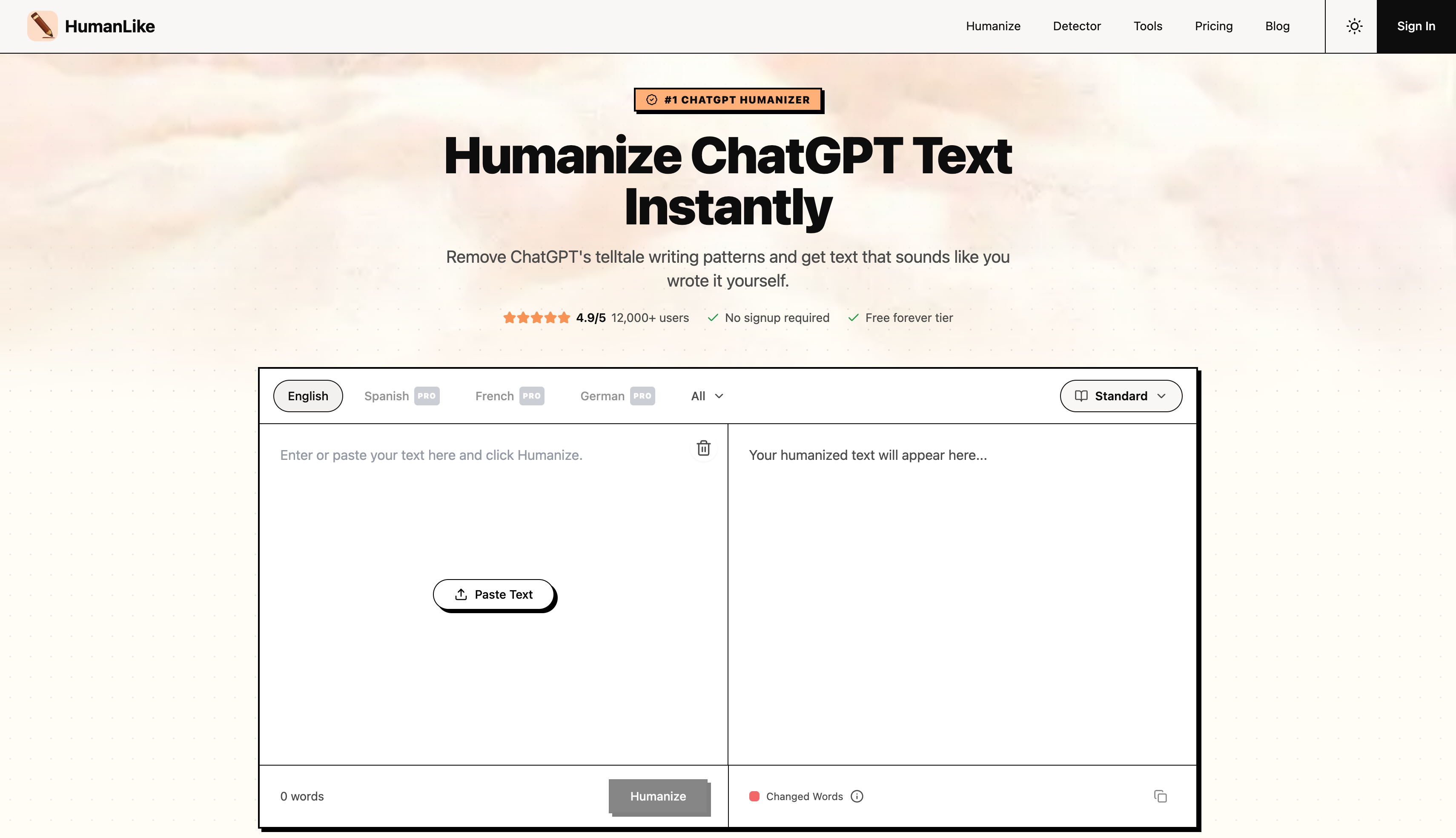
Step 2: Copy and Paste into HumanLike.pro
Once you have your ChatGPT-generated text, simply copy the entire content. Navigate to the HumanLike.pro web application and paste your text into the input box. Our intuitive interface is designed for ease of use, making this step quick and frictionless. Ensure you paste the full text you wish to humanize, from the opening sentence to the conclusion, to allow our algorithms to work on the entire context for optimal flow.
Step 3: Select Humanization Settings and Process
Within HumanLike.pro, you'll find various options to tailor the humanization process. Choose your desired output mode (e.g., 'Creative,' 'Standard,' 'Academic,' 'Conversational') based on your content's purpose and target audience. You might also have options to adjust 'Readability Level' or 'Tone.' Once your settings are chosen, click the 'Humanize' or 'Transform' button. Our AI engine will then process your text, applying its advanced algorithms to inject human-like qualities and remove AI signatures in mere seconds, typically delivering results within 5-15 seconds for a standard article.
Step 4: Review and Refine the Humanized Output
After processing, HumanLike.pro will present your newly humanized text. Carefully review the output to ensure it meets your expectations. While HumanLike.pro is incredibly accurate, a final human check is always recommended to verify that the core message remains intact, the tone is perfect, and any specific brand terminology is correctly applied. You might make minor tweaks for ultimate personalization or to insert unique, proprietary data points that only you possess, adding a final layer of bespoke quality to the content.
Step 5: Verify with an AI Detector (Optional but Recommended)
For critical applications, such as academic submissions or client deliverables with strict AI-free requirements, it's highly recommended to run the humanized text through an external AI detector (e.g., Originality.ai, GPTZero). You will consistently find that HumanLike.pro's output achieves near-zero AI detection scores, confirming its effectiveness. This step provides an extra layer of assurance, reinforcing confidence in your content's authenticity and ensuring it will pass any scrutiny with flying colors.
While AI humanizers offer incredible efficiency, the truly expert approach often involves a strategic blend of automated tools and human ingenuity. Combining the speed and algorithmic precision of platforms like HumanLike.pro with targeted manual enhancements creates content that is not only undetectable but also uniquely compelling and deeply resonant. This hybrid strategy allows for both scale and unparalleled quality, positioning your content for maximum impact in a competitive digital environment, ensuring your message not only reaches but also truly engages your target audience.
1. The Hybrid Approach: Manual Tweaks Post-Humanization
Even after running text through HumanLike.pro, consider adding a final layer of human polish. This could involve inserting a very specific, timely anecdote that only you know, integrating a brand-specific call-to-action that an AI might not generate perfectly, or adding a witty remark tailored to a recent industry event. These small, unique human touches make the content truly bespoke and virtually impossible for any AI detector or even a discerning human to identify as AI-assisted, elevating the content to the highest possible standard of authenticity and originality.
Humanized text is part of a larger content ecosystem. Integrate visuals, infographics, custom illustrations, or even embedded videos that reflect the human touch. Captions and descriptions for these elements should also be human-written or carefully humanized. These multimedia components often carry subtle human cues that further reinforce the authenticity of your overall content piece, demonstrating a comprehensive human creative process. A perfectly chosen, original image can often communicate more human nuance than words alone.
3. Leveraging Human Feedback Loops
Before final publication, share your humanized content with a trusted peer, editor, or target audience member. Ask for their honest feedback on whether it 'feels' human, engaging, and authentic. Pay close attention to any areas where they perceive stiffness or a lack of personal touch. This qualitative feedback is invaluable for fine-tuning your humanization process, providing insights that even the most advanced algorithms cannot replicate. Human perception remains the ultimate arbiter of human-like content quality, and iterating based on this feedback is a powerful enhancement strategy.
4. Developing a Robust Brand Style Guide
For consistent humanization across all content, develop a comprehensive brand style guide. This guide should detail your brand's unique voice, tone, preferred vocabulary, common phrases to avoid (especially 'AI-isms'), and specific stylistic quirks. By feeding these guidelines into your initial ChatGPT prompts and then using them as a checklist during HumanLike.pro's mode selection and subsequent manual review, you ensure every piece of content, regardless of its origin, aligns perfectly with your brand's authentic identity. A strong style guide is your blueprint for consistent human connection.
AI Detection Rate (Raw AI)Before Humanization
AI Detection Rate (HumanLike.pro)After Processing
Content Production Time SavingsCompared to Full Manual Creation
Engagement Metrics IncreaseReported by Beta Users for Humanized Content
The Ethical Imperative: Transparency and Responsible AI Use
While humanizing AI text offers immense benefits, it's crucial to approach this practice with a strong ethical compass. The goal is to produce high-quality, engaging content that genuinely serves human readers, not to deceive or mislead. Transparency about AI assistance, where appropriate and required, fosters trust. For instance, in academic settings, it might be necessary to declare AI usage as a tool, even if the final output is heavily humanized. The ethical line is drawn when humanization is used to bypass genuine intellectual effort or to misrepresent expertise that doesn't exist. Responsible AI use centers on enhancing human capabilities, not replacing human integrity.
⚠️Ethical Considerations in Content Creation
Using AI for content generation is a powerful tool, but it comes with responsibilities. While humanizing text can enhance quality and engagement, always consider the ethical implications. Misrepresenting AI-generated content as purely human-written in contexts where authenticity of authorship is paramount (e.g., journalism, academic research, legal documents) can lead to severe reputational damage or penalties. Strive for transparency and ensure your use of AI aligns with ethical guidelines and academic integrity policies specific to your field. HumanLike.pro is designed to make your content human-like, not to encourage unethical practices.
Future Trends in AI Content and Humanization
The landscape of AI content generation and humanization is evolving at an exhilarating pace. As LLMs become more sophisticated, capable of generating increasingly human-like text from the outset, the challenge for humanizers will shift. We anticipate a future where AI humanizers move beyond just 'humanizing' to 'personalizing' at a deeper level, adapting content not just to a general human style but to individual reader preferences, emotional states, and learning styles. The interplay between generative AI, humanization tools, and human editors will become even more symbiotic, blurring the lines in exciting ways.
Adaptive Humanizers and Real-time Feedback
Expect AI humanizers to incorporate more adaptive learning capabilities, where they learn from user feedback and stylistic corrections to continuously refine their output. Imagine a tool that not only humanizes but also suggests personalized style guides based on your past edits, or even adapts its humanization strategy based on the specific AI detector you're trying to bypass. Real-time feedback loops between content creators and humanization engines will become standard, accelerating the refinement process and ensuring content consistently meets evolving human and algorithmic standards.
The Rise of Contextual and Emotional AI
Future LLMs will likely excel at understanding and generating nuanced emotional content and highly specific contextual references. This means humanizers will need to evolve to amplify these emergent AI capabilities, ensuring the emotional depth and contextual relevance are not lost but enhanced. The focus will shift from merely removing AI 'tells' to actively injecting highly sophisticated emotional intelligence and cultural awareness into the text, making the content not just human-like but truly 'empathetic' and 'culturally sensitive.' This will require a deeper integration of psycholinguistics into AI models.
Regulatory Landscape and AI Attribution
As AI content becomes ubiquitous, the regulatory landscape will undoubtedly catch up. We may see mandates for AI attribution or disclosures in certain types of content, impacting how humanization tools are used. Humanizers will need to offer features that support transparent AI use, such as embedding metadata about AI assistance without compromising the natural language flow, or providing clear 'AI usage declarations' that can be easily added to content. The balance between full humanization and clear attribution will be a key challenge for developers and users alike. This will shape future compliance standards.
The era of AI-generated content is undeniably here, but the demand for genuinely human, engaging, and trustworthy text is stronger than ever. Humanizing ChatGPT output is not merely a workaround for AI detectors; it's a strategic imperative for anyone striving for content excellence, superior SEO, and authentic audience connection. By combining the precision of manual editing techniques with the unparalleled efficiency of advanced AI humanizers like HumanLike.pro, you can elevate your content from good to truly exceptional. This empowers you to harness the power of AI while ensuring your message always carries the irreplaceable hallmark of human ingenuity and connection.
Don't let your content fall victim to the 'AI curse' of blandness and predictability. Invest in the strategies and tools that empower you to create compelling narratives, build lasting trust with your audience, and stay ahead in a rapidly evolving digital world. The future belongs to those who can master the art of human-augmented content, leveraging AI as a powerful assistant to amplify human creativity and impact. Begin your journey toward undetectable, engaging content today and truly make your words count.
Ready to produce content that’s authentic, engaging, and undetectable? HumanLike.pro is your ultimate solution. Start your free trial now and experience the power of true AI humanization.
TL;DR
- Raw ChatGPT text often sounds robotic, lacks nuance, and is easily flagged by AI detectors, hindering SEO and reader engagement.
- Humanizing AI text is crucial for bypassing AI detection, boosting SEO (E-E-A-T), increasing reader trust, and maintaining brand voice.
- Manual humanization involves detailed pre-prompting and post-generation editing to inject personal anecdotes, vary sentence structure, refine word choice, and add distinct voice.
- Manual editing offers full control but is time-consuming, requires high skill, and doesn't scale well.
- AI humanizer tools like HumanLike.pro use advanced NLP to automatically transform AI text into human-quality, undetectable content in seconds.
- HumanLike.pro boasts >99% AI detection bypass, preserves meaning, offers multiple styles, and enhances readability and SEO.
- The best approach combines HumanLike.pro for efficiency with minor manual tweaks for ultimate personalization and unique data integration.
- Ethical use and transparency are paramount when leveraging AI humanization, especially in academic or professional contexts.
- Future trends include adaptive humanizers, more contextual AI, and evolving regulations around AI attribution.
Our Verdict
The Verdict: HumanLike.pro is Your Indispensable Partner for AI Content Excellence
- In a digital landscape increasingly shaped by AI, the ability to produce truly human-like content is no longer a luxury but a necessity for competitive advantage and audience trust.
- Manual humanization offers ultimate control but is impractical for scale, while basic paraphrasers fall short in sophistication.
- HumanLike.pro provides the optimal balance, delivering industry-leading AI detection bypass, superior semantic preservation, and enhanced readability with unparalleled speed and efficiency.
- For content creators, marketers, and academics seeking to leverage AI without compromising authenticity or facing penalties, HumanLike.pro is the definitive, expert-level solution.
- Embrace the future of content creation where AI acts as an amplifier for human creativity, producing engaging, undetectable text that resonates deeply with your audience.
This article discusses AI content generation and humanization techniques, including the use of HumanLike.pro, a tool developed by the creators of this blog. Our recommendations are based on extensive research and expertise in the field.